Investigation
A Thousand Screens at $3,700 Flat: The Eight Companies Behind BGN's Rp535 Billion "LED" Package
How one line in Indonesia's procurement data leads to two clusters of interlocking companies, a shared office tower on Daan Mogot, and a shipment of Chinese smartboards priced to the dollar.
How one line in Indonesia’s procurement data leads to two clusters of interlocking companies, a shared office tower on Daan Mogot, and a shipment of Chinese smartboards priced to the dollar.
Between March 6 and March 17, 2025, nine container shipments left Shekou, China, for Tanjung Priok, Jakarta. Customs records describe the cargo identically on every manifest: “86Inch Interactive Flat Panel”, HS code 84714190. The importer on all nine was PT Karya Makmur Nusantara Bersama, a company registered at a shophouse in Pantai Indah Kapuk, North Jakarta. The exporter on all nine was Guangzhou Wantong Technology Company Limited.
The quantities add up to exactly 1,000 sets. The declared values are stranger: 134 sets for USD 495,800; 132 for USD 488,400; 67 for USD 247,900; 66 for USD 244,200. Every line resolves to precisely USD 3,700 per set.
Until 2025, this importer’s customs history consisted of motorcycle workshop equipment — “Special Tools For Honda,” “Special Tools For Yamaha,” handheld diagnostic scanners from Shenzhen, all brought in during 2020. The pivot from motorcycle tools to interactive flat panels came months before Indonesia’s newest and best-funded agency went shopping for exactly that kind of screen.
The package
In the government’s procurement realization data for fiscal year 2026, Badan Gizi Nasional (agency code L112) — the National Nutrition Agency that runs the Makan Bergizi Gratis free-meals program — records eight awards under one identical name: “Paket Pekerjaan Pengadaan LED Badan Gizi Nasional Tahun 2026.” All eight went through e-purchasing, the e-katalog channel, rather than a competitive tender. Each award went to a different company.
| # | Vendor | Recorded value |
|---|---|---|
| 1 | PT Tiga Bersaudara Nusantara | ≈ Rp73.90 billion |
| 2 | PT Nusa Persada Khatulistiwa | ≈ Rp73.80 billion |
| 3 | PT Makmur Sumber Redjeki | ≈ Rp73.80 billion |
| 4 | PT Rthree Global Persada | ≈ Rp73.70 billion |
| 5 | PT Intan Paulima | ≈ Rp73.70 billion |
| 6 | PT Maju Negeri Perkasa | ≈ Rp73.70 billion |
| 7 | PT Gema Patriot Nusantara | ≈ Rp46.30 billion |
| 8 | PT Karya Pendidikan Bangsa | ≈ Rp46.20 billion |
| Total | ≈ Rp535 billion |
The values are recorded to the rupiah — Rp73,900,001,580 here, Rp73,800,001,680 there — six of them packed within Rp200 million of one another just above Rp73.7 billion, the remaining two within Rp100 million of each other at Rp46.2–46.3 billion. Eight companies, one package name, a spread of less than half a percent.
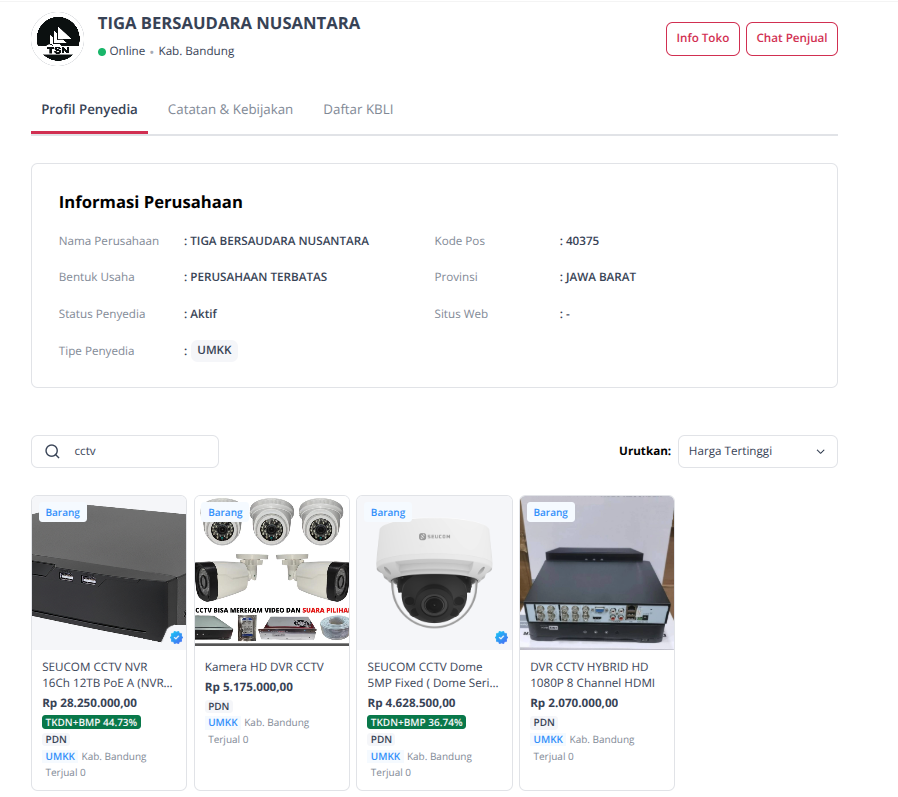
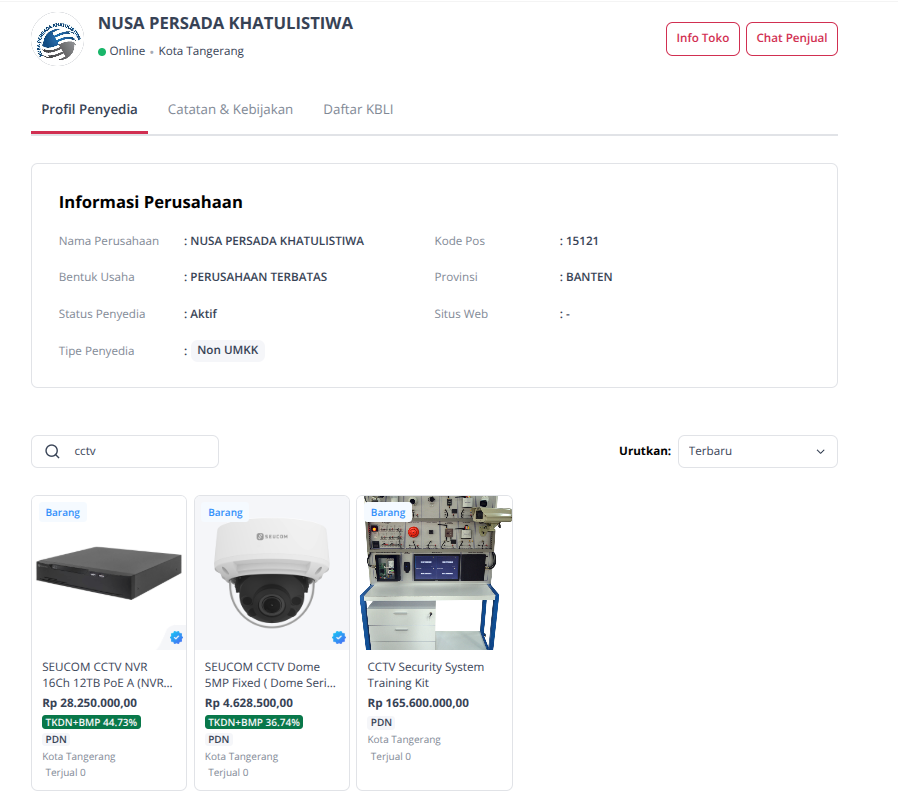
What is an “LED” in this context? The e-katalog storefront of the largest awardee, PT Tiga Bersaudara Nusantara, answers at the top of its own listing: “IFP 110 Inch Layar 4K Kamera AI” — an interactive flat panel, the touchscreen smartboard familiar from classrooms and boardrooms — priced at Rp352,000,000 per unit and tagged PDN, domestic product. The same storefront sells SEUCOM-brand CCTV recorders and cameras, rice transplanters, combine harvesters, solar power stations, adjustable student desks, upright freezers, and bread proofers. As of this writing, every listed item shows “Terjual 0” — zero sold.
The network
Company registry records collapse five of the eight “competing” vendors into two groups.
The Bandung group. PT Tiga Bersaudara Nusantara (Kabupaten Bandung, postal 40375) lists Raras Annisa Putri as director and Desmanetty Anita as commissioner, with registry person-records dated July 2025 — months before the award. PT Rthree Global Persada (Komplek GBA 1 No. E43, Kabupaten Bandung) lists the same Raras Annisa Putri, this time as commissioner. PT Gema Patriot Nusantara (Komplek Town Place, Jl. Sentra Raya No. 19, Cimahi) lists the same Desmanetty Anita, this time as director. Identical personal contact numbers recur across the three filings. Two names, three companies, three awards, roughly Rp194 billion combined.
The Daan Mogot group. PT Nusa Persada Khatulistiwa (Batuceper, Tangerang) lists Yudi Amiardi Iskandar as director and Puji Astuti as commissioner; its corporate shareholder is PT Medikatama Laboratory Sukses. PT Karya Pendidikan Bangsa lists the same Yudi Amiardi Iskandar as director and Wanti Purniasih as commissioner; its corporate shareholder is PT Karya Makmur Nusantara Bersama. The web tightens from there: Wanti Purniasih is director of Medikatama Laboratory Sukses; Puji Astuti is director of Karya Makmur Nusantara Bersama — the company that imported the thousand flat panels. Karya Pendidikan Bangsa and Medikatama are both registered at the same address: PJS Tower, Jl. Daan Mogot Km 14 No. 1, Jakarta Barat, postal code 11840. Three names, four companies, two awards worth roughly Rp120 billion, and the group’s own importer holding a thousand screens.
One more registration is worth recording. The CCTV brand sold on the Bandung group’s storefront is SEUCOM. The company registry lists PT Digital Seucom Indonesia — president director Prayitno Susanto, directors Deri Fernaldi and Chandra Liestiawan, commissioner Ivani Franciska — at Jalan Daan Mogot Km 14 Nomor 1, postal 11840: the same address as the PJS Tower companies. Registry records show no shared officers between Digital Seucom and either vendor group; the overlap, as documented, is the address and the brand.
The remaining three vendors show no personnel overlap with either group in the records reviewed. PT Makmur Sumber Redjeki (Podomoro City, Jakarta Barat) is directed by Charles and Stephanie Prayogo and has its own customs history importing plastic containers from Qingdao. PT Maju Negeri Perkasa (Ruko Terrace Walk, Point 8) sits on the same Daan Mogot Km 14 corridor as PJS Tower — a strip where more than seventy companies are registered, so proximity alone proves nothing. PT Intan Paulima (Ruko Mall Klender, Jakarta Timur) has tender history in LED lighting and CCTV going back to 2016.
The local-content label and the customs record
The storefront’s SEUCOM CCTV dome camera (5MP fixed) is listed at Rp4,628,500 including 12% VAT, carrying a local-content claim of TKDN+BMP 36.74%; the 16-channel NVR at Rp28,250,000 claims 44.73%. The 110-inch interactive panel at Rp352,000,000 is tagged PDN — domestic product.
The customs database tells a parallel story about the product category. The Daan Mogot group’s importer brought in its 1,000 interactive flat panels from Guangzhou at USD 3,700 per set — about Rp60 million at prevailing rates, for an 86-inch unit. The catalog lists a 110-inch unit, a larger and costlier size, so the two figures are not directly comparable; what the records establish is that the group’s supply chain for this product class runs through Shekou, and that the declared unit price never varied by a dollar across nine shipments.
For the cameras, public customs data offers a market yardstick. Large import lines of comparable fixed IP dome cameras cluster far below the catalog price: 1,000 Huawei 2MP fixed domes imported into Indonesia in December 2021 at roughly USD 94 per unit; 5,500 units of a 2MP IP dome into India in 2022 at roughly USD 43 per unit; 331 branded 2MP IP66 domes into Indonesia in 2023 at roughly USD 335 per unit. The SEUCOM 5MP dome’s pre-tax catalog price works out to roughly USD 250 — inside the plausible range for a mid-spec unit once importer margin, warranty, and compliance costs are added, but multiples above the cheapest comparable landed costs. No customs record under the SEUCOM name was found; house brands typically enter the country under their manufacturer’s paperwork.
The money so far
Treasury payment data is published through fiscal 2025; the 2026 disbursement records are not yet available, so whether BGN has paid on the LED package cannot yet be checked. What the ledger through 2025 does show is a divided field: five of the eight vendors are working suppliers with years of paid government contracts behind them, and three have never received a treasury payment at all.
The paid five are familiar names in other agencies’ books. Nusa Persada Khatulistiwa carries twenty-one payment records, most from Universitas Mulawarman and Universitas Jember in late 2023, and one that lands with some irony: in December 2025, the Attorney General’s Office — the institution now prosecuting the BGN case — paid the company Rp4,954,905,013 on an unrelated procurement. Makmur Sumber Redjeki has been paid steadily by the Ministry of Agriculture’s food-crops directorate through 2024 and 2025, its largest single disbursement exceeding Rp7.5 billion. Karya Pendidikan Bangsa drew over Rp8 billion from the Manpower Ministry’s vocational-training directorate in 2024 and another Rp4 billion in early 2025. Maju Negeri Perkasa’s eighteen payments all trace to a single client and a single month — Universitas Mulawarman, December 2023. Intan Paulima’s entire treasury history is one entry: Rp5.7 million from the KPK in 2023.
The unpaid three are the Bandung group in full — Tiga Bersaudara Nusantara, Rthree Global Persada, Gema Patriot Nusantara. Registered in 2025, awarded a combined Rp194 billion in 2026, and, as far as the published ledger reaches, never yet paid a rupiah by the Indonesian state.
The case next door
None of this appears in the criminal file — and that distinction matters. The Kejaksaan Agung’s investigation into BGN’s 2025–2026 program governance, opened with the detention of former agency head Dadan Hindayana and deputies Sony Sonjaya and Lodewyk Pusung on June 3, 2026, and since expanded to at least seven suspects including businessman Asep Yusuf Somantri, PT Yasa Artha Trimanunggal commissioner Andri Mulyono, and police Brigadier General Lalu Muhammad Iwan Mahardan, centers on other items: mark-ups in electric motorcycles (a 21,801-unit e-katalog contract signed October 14, 2025), 32,000 pairs of shoes, 31,994 tablets, 5,400 seventy-five-inch televisions — and, per Sonjaya’s account through his lawyer Krisna Murti, a contract of more than Rp300 billion for CCTV and fingerprint devices at 5,000 kitchen sites that the vendor allegedly could not show installed anywhere. Prosecutors rejected Sonjaya’s justice-collaborator application in July, calling him a principal actor.
The LED package is a different procurement: different year, different mechanism, different commodity. No vendor named in this article has been named a suspect, and no published reporting has linked the LED package to the investigation. Current BGN head Nanik Sudaryati Deyang, whose name circulated in connection with the case, has denied any role; in a televised interview quoted by Radar Kukar on June 14, 2026, she insisted she was “tidak pernah terlibat dalam praktik penyimpangan anggaran” — never involved in budget irregularities — and said her duties did not touch the technical management now under scrutiny. Requests for comment for this article were not made to the vendors; their side of the story is absent here, and readers should weigh that.
What is legal, and what is notable
Nothing described above is, by itself, unlawful. Splitting a procurement across multiple e-katalog awards is permitted. One person may lawfully direct or commission several companies. Companies may share an address, a building, a registered agent. A reseller may list smartboards next to combine harvesters. An importer may declare uniform unit prices. New companies may win government work in their first year. These are ordinary features of Indonesian commerce, and the payment histories show most of these firms doing routine, paid, delivered work for ministries and universities.
What the documents nonetheless establish is concentration. A single Rp535 billion package, awarded under one name through a non-competitive channel, resolves on paper into: two ownership groups controlling five of eight awards worth some Rp314 billion; three of those companies registered in 2025 with no payment history anywhere in the treasury data; award values coordinated to within fractions of a percent; a supply chain running through one importer whose thousand screens were declared at a single flat price; and a camera brand whose registered company sits in the same building as one vendor group while its products fill the other group’s catalog. Each fact has an innocent explanation available. The number of facts requiring one is the story.